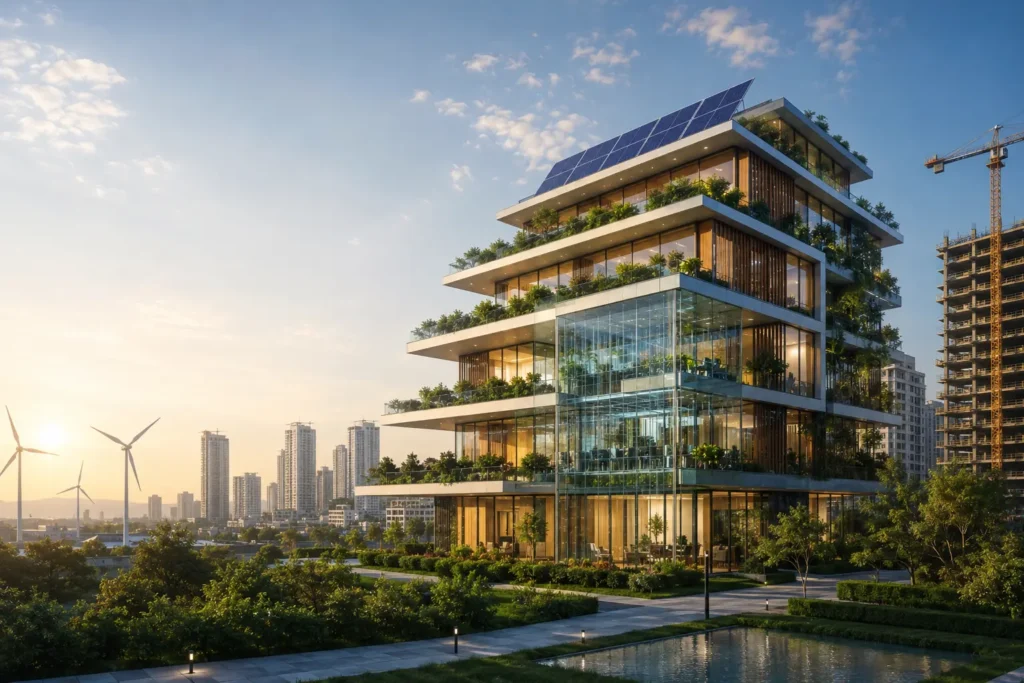
Building a luxury villa in Lebanon typically costs between USD 1,500 and USD 4,000+ per square meter, excluding land acquisition. However, the final investment depends on far more than the villa’s size. Site topography, structural complexity, architectural design, material specifications, imported finishes, and mechanical systems all influence the overall budget.
For most custom-built luxury residences, the greatest opportunities to control costs come before construction begins. Detailed design coordination, accurate Bills of Quantities (BOQs), early material selection, and experienced project management significantly reduce delays, unexpected variations, and budget overruns.
This guide explains the major cost drivers, current market considerations, construction timelines, and planning strategies to help homeowners, investors, and developers make informed decisions before breaking ground.
Key Takeaways
What Is the Average Cost to Build a Luxury Villa in Lebanon?
One of the first questions homeowners ask is:
“How much should I budget to build a luxury villa?”
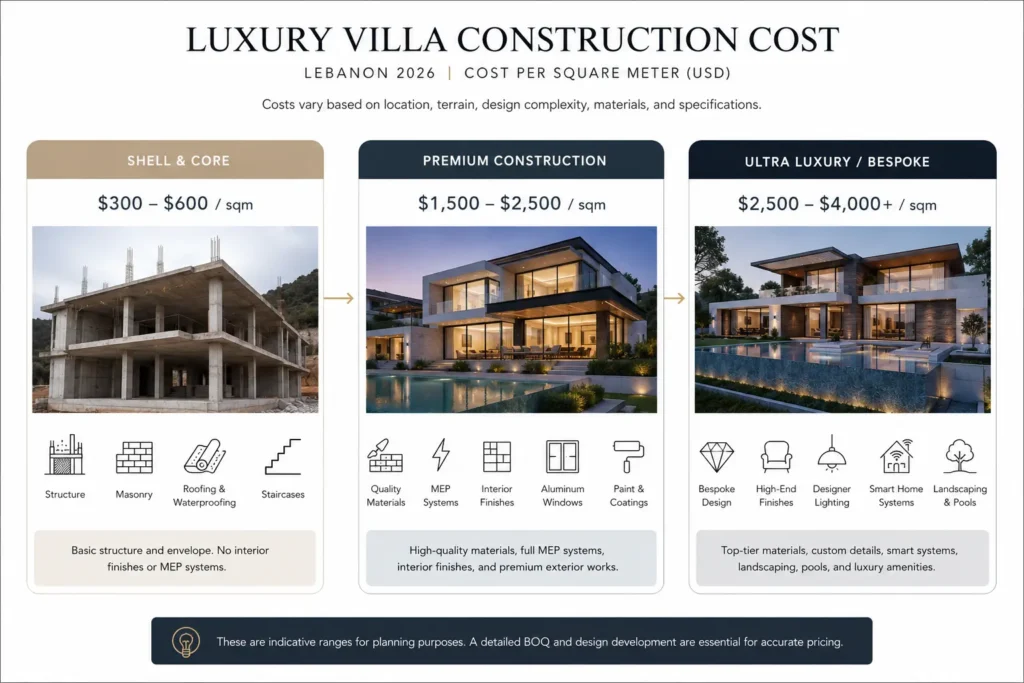
While every project is unique, today’s Lebanese market generally falls within the following indicative construction ranges excluding land costs, professional fees, and municipality taxes.
|
Construction Level |
Typical Cost (USD/sqm) |
|---|---|
|
High-Quality Shell & Core |
$300 – $500 / sqm |
|
Premium Residential Construction |
$900 – $1,800 / sqm |
|
Ultra-Luxury Bespoke Villas |
$2,500 – $4,000+ / sqm |
These figures should be considered planning benchmarks rather than fixed prices. A 700 sqm villa on a flat site in Beirut will have a very different construction profile from a similarly sized residence overlooking the mountains of Keserwan or Faqra, where excavation, retaining structures, and complex foundations often represent a significantly larger share of the overall budget.
For this reason, experienced contractors rarely estimate projects based solely on cost per square meter. Instead, they evaluate the complete scope of work including the site, structural requirements, architectural intent, building systems, and material specifications before establishing an accurate construction budget.
How Is the Construction Budget Typically Distributed?
While every project differs, luxury residential developments generally follow a similar allocation across the major construction disciplines.
|
Construction Component |
Typical Share of Total Budget |
|---|---|
|
Site Preparation & Excavation |
5–10% |
|
Structural Works |
20–25% |
|
Building Envelope (Façade, Roofing & Waterproofing) |
15–20% |
|
Mechanical, Electrical & Plumbing (MEP) |
15–20% |
|
Interior Finishes & Joinery |
25–35% |
|
Landscaping, Pools & External Works |
5–10% |
Rather than focusing exclusively on reducing individual line items, successful luxury projects prioritize cost certainty. Investing in proper design coordination and procurement planning at the beginning of the project often produces greater long-term savings than selecting lower-cost materials later in the construction process.
What Has the Greatest Impact on Construction Costs?
Many homeowners assume that villa size is the primary factor affecting cost. In reality, it is only one part of the equation.
The greatest cost differences usually arise from decisions made during the design phase, long before construction begins.
1. Site Topography and Structural Engineering
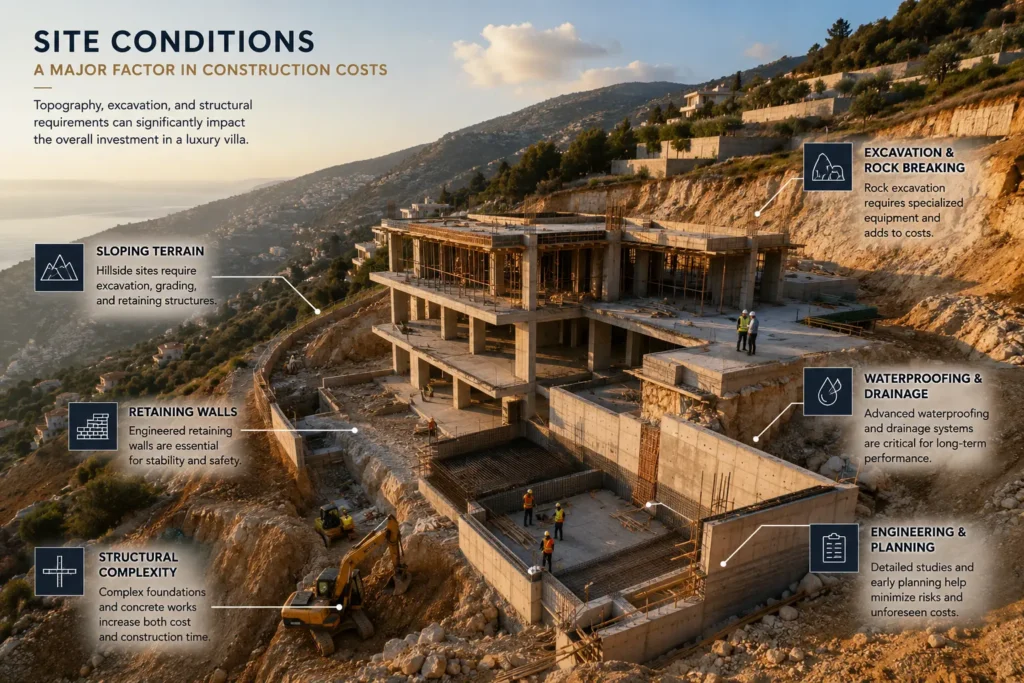
Lebanon’s diverse landscape presents both opportunities and engineering challenges. Coastal sites, urban plots, and mountainous terrain each require different structural solutions.
Luxury villas built on sloping land—particularly in areas such as Keserwan, Faqra, Kfardebian, Metn, and Batroun—often require:
- Extensive excavation and rock breaking.
- Reinforced concrete retaining walls.
- Advanced waterproofing systems.
- More complex foundation engineering.
- Careful stormwater management.
These requirements increase construction complexity and frequently extend the project timeline.
For this reason, geotechnical investigations should never be treated as optional. Soil testing and topographic surveys provide engineers with the information needed to design safe, efficient foundations while reducing the risk of expensive structural modifications later in the project.
2. Does Architectural Design Affect Construction Costs?
Absolutely.
Two villas with identical floor areas can have dramatically different budgets because architectural complexity has a direct influence on labour, materials, structural engineering, and construction sequencing.
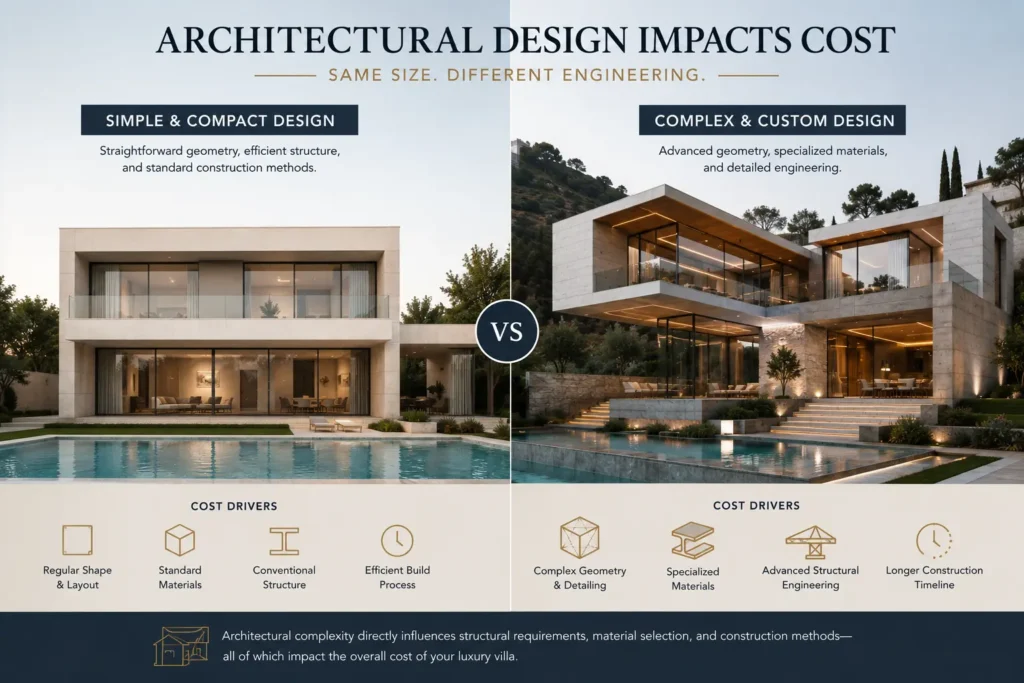
Design features that typically increase construction costs include:
- Large cantilevered structures.
- Double-height living spaces.
- Floor-to-ceiling glazing.
- Custom natural stone façades.
- Infinity pools integrated into sloping sites.
- Floating staircases.
- Bespoke steelwork.
- Large-span open-plan layouts.
These elements often require closer collaboration between architects, structural engineers, MEP consultants, and specialist contractors to achieve the intended design while maintaining structural performance and construction efficiency.
How Do Materials and Finishes Influence the Total Construction Cost?
For most luxury villas, materials and finishes account for the largest portion of the overall construction budget. While structural works create the building’s framework, the quality of finishes ultimately defines its appearance, comfort, longevity, and market value.
In Lebanon, premium residential projects typically combine locally sourced materials with carefully selected imported products. This balanced approach allows homeowners to achieve international quality standards while managing procurement costs and project timelines.
Rather than assuming that imported materials are always superior, experienced project teams evaluate each product based on performance, durability, maintenance requirements, and suitability for the local climate.
1. Imported Finishes and Custom Features
Many high-end residential projects include imported products for areas where craftsmanship, precision, and long-term performance are critical.
These commonly include:
- Custom kitchens from European manufacturers.
- Designer lighting fixtures for living areas and outdoor spaces.
- Premium furniture and bespoke joinery.
- Large-format porcelain slabs and natural stone.
- High-performance aluminium systems with thermal breaks.
- Architectural glazing and panoramic sliding doors.
Because many of these products are manufactured overseas, procurement should begin well before installation. Depending on the manufacturer and country of origin, production, shipping, customs clearance, and local delivery can require several months.
For this reason, selecting finishes during the design phase, not after construction has begun, helps prevent delays and protects the overall construction schedule.
2. Local Materials Continue to Play an Important Role
Lebanon has a long tradition of skilled craftsmanship and high-quality natural materials.
Many luxury villas successfully incorporate:
- Premium Lebanese natural stone.
- Locally fabricated steelwork.
- Custom woodwork and cabinetry.
- Decorative metal fabrication.
- Handcrafted architectural details.
Combining local craftsmanship with imported premium finishes often produces the best balance between architectural quality, project efficiency, and long-term value.
Why Are Mechanical, Electrical and Plumbing (MEP) Systems So Important?
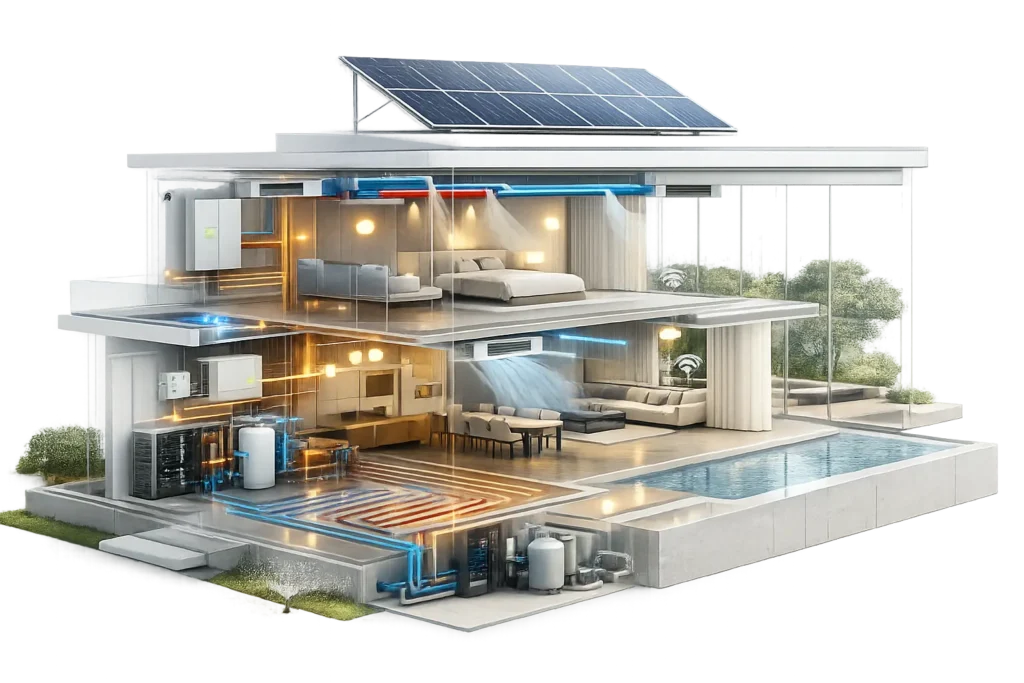
In luxury residential construction, many of the home’s most valuable features remain completely hidden once construction is complete.
Mechanical, Electrical and Plumbing (MEP) systems form the infrastructure that supports everyday comfort, energy efficiency, safety, and long-term building performance.
Unlike finishes, these systems become difficult and expensive to modify after construction. Careful planning during the design stage is therefore essential.
Modern luxury villas increasingly incorporate:
- High-efficiency VRF/VRV air conditioning systems.
- Underfloor heating where appropriate.
- Advanced ventilation systems.
- Water filtration and pressure management.
- Backup power solutions.
- Solar photovoltaic (PV) integration.
- Smart lighting controls.
- Home security and CCTV networks.
- Structured data and fibre-optic cabling.
Well-designed MEP systems improve not only comfort but also operational efficiency and future maintenance.
Smart Homes Are Becoming the New Standard
Smart-home technology has evolved from a luxury feature into a practical investment for many homeowners in Lebanon.
Beyond convenience, integrated automation allows residents to monitor energy consumption, improve security, and manage essential building systems from a single interface.
The most frequently requested features include:
- Intelligent lighting scenes
- Climate control
- Motorized curtains and blinds
- Smart irrigation
- CCTV integration
- Video intercom systems
- Remote gate access
- Audio distribution
- Energy monitoring
- Mobile application control
Many premium villas also adopt internationally recognised automation platforms such as KNX or Crestron, allowing different building systems to communicate through a single control platform.
The result is a home that is easier to operate, more energy efficient, and better prepared for future technology upgrades.
Which Architectural Trends Are Shaping Luxury Villas in Lebanon?
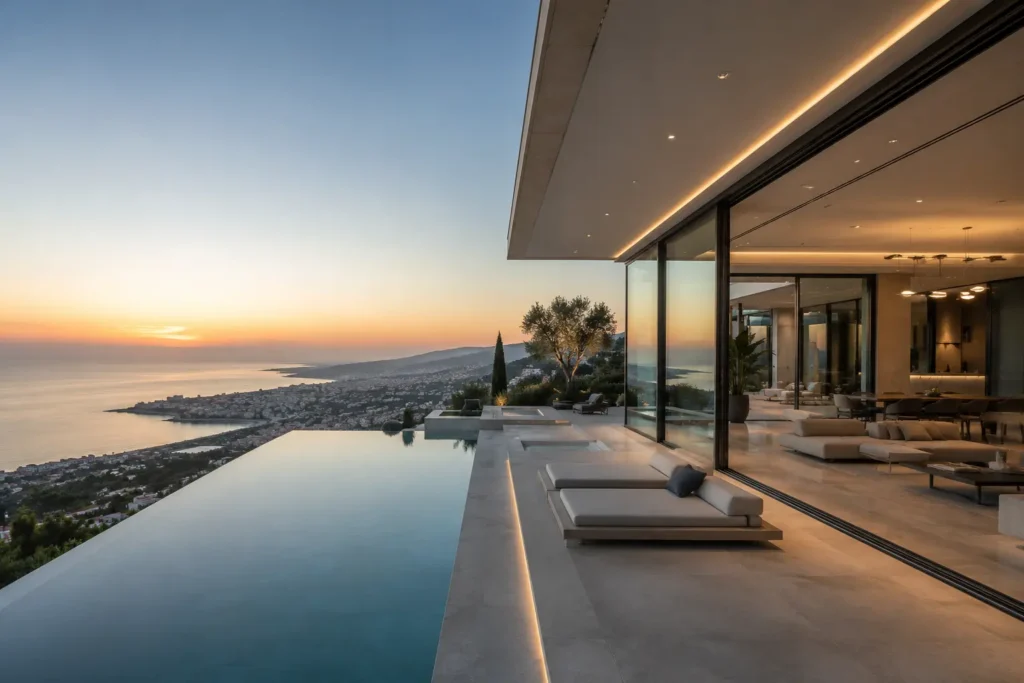
Luxury residential architecture in Lebanon has evolved considerably over the past decade.
Rather than focusing on excessive ornamentation, today’s projects prioritise simplicity, natural light, sustainability, and a stronger connection between indoor and outdoor living spaces.
Several design trends have become particularly popular.
1. Seamless Indoor-Outdoor Living
One of the defining characteristics of contemporary luxury villas is the integration of interior spaces with surrounding landscapes.
Large sliding glass systems, covered terraces, infinity pools, landscaped gardens, and outdoor entertainment areas create a continuous transition between inside and outside.
This approach is particularly suited to Lebanon’s Mediterranean climate, allowing homeowners to enjoy outdoor living throughout much of the year.
Achieving these open spaces often requires advanced structural engineering to minimise visible columns while maintaining the building’s structural integrity.
2. Larger Open Spaces and Higher Ceilings
Modern luxury homes increasingly favour spacious, open-plan layouts over compartmentalised rooms.
Features commonly requested include:
- Double-height entrance halls.
- Large family living areas.
- Open kitchen and dining spaces.
- Home offices.
- Private wellness areas.
- Home cinemas.
- Wine cellars.
- Fitness rooms.
Ceiling heights between 3.2 and 4.2 metres have also become increasingly common in principal living spaces, creating brighter interiors and allowing for larger glazing systems and feature lighting installations.
3. Sustainability Is No Longer an Optional Upgrade
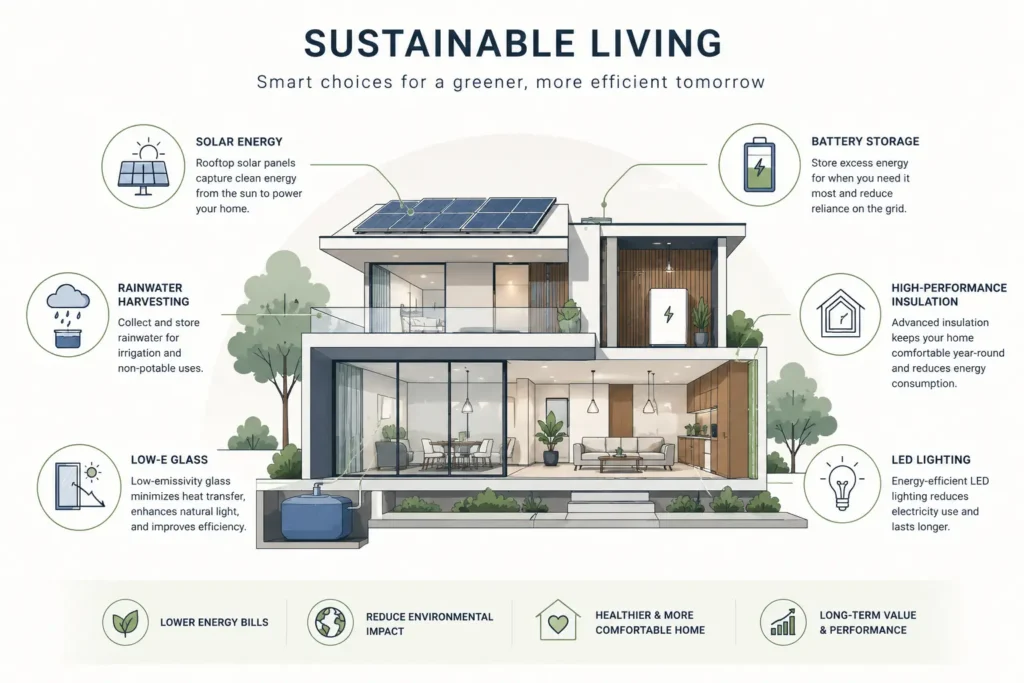
Homeowners today are placing greater emphasis on long-term operational efficiency rather than focusing solely on construction costs.
As energy prices fluctuate and sustainability becomes a higher priority, many luxury villas are designed to reduce energy consumption while improving occupant comfort.
Common sustainable design strategies include:
- High-performance thermal insulation.
- Low-emissivity (Low-E) double glazing.
- Thermally broken aluminium systems.
- Rooftop solar photovoltaic panels.
- Battery energy storage.
- LED lighting throughout the property.
- Water-efficient plumbing fixtures.
- Smart irrigation systems.
- Native landscaping requiring less irrigation.
These measures not only reduce operating costs but also improve indoor comfort and contribute to the long-term value of the property.
Key Insight
The most successful luxury villas are not necessarily those with the highest construction budgets. They are the projects where architecture, engineering, procurement, and execution are coordinated from the very beginning. Careful planning almost always delivers better results than expensive corrections made during construction.
What Is the Typical Timeline for Building a Luxury Villa in Lebanon?
Building a luxury villa is a multi-phase process that requires careful planning long before construction begins. While every project differs, most custom residences follow a similar sequence.
|
Project Phase |
Typical Duration |
|---|---|
|
Architectural Concept & Design |
2–4 months |
|
Engineering, BOQ & Tendering |
2–3 months |
|
Permits & Municipality Approvals |
Varies by municipality |
|
Structural Construction |
5–7 months |
|
MEP Installation |
3–5 months |
|
Interior Finishes |
5–7 months |
|
Landscaping & Final Completion |
1–2 months |
Overall, homeowners should typically allow 20–30 months from the first design meeting to project completion. The construction phase itself generally takes 16–24 months, depending on the size of the villa, site conditions, and the complexity of the design.
Rather than the size of the villa, the biggest factors affecting the schedule are the level of customization, procurement of imported materials, and how early design decisions are finalized.
Moreover, construction costs should always be evaluated alongside long-term operating efficiency. Discover how building performance influences energy efficiency, comfort, and lifetime building value.
What Are the Most Common Causes of Budget Overruns?
Budget overruns are often associated with rising material prices. While market conditions can influence costs, our experience shows that the largest overruns are usually caused by planning decisions, not construction itself.
1. Changes to the Design During Construction
Modifying layouts, enlarging openings, relocating services, or upgrading finishes after work has started can affect multiple trades simultaneously. What appears to be a simple design change often requires revisions to structural works, MEP systems, and finishing details, increasing both cost and construction time.
The earlier key decisions are made, the easier they are to implement.
2. Incomplete Drawings or Bills of Quantities
Beginning construction with incomplete documentation creates uncertainty for everyone involved.
A detailed set of architectural and engineering drawings, supported by a comprehensive Bill of Quantities (BOQ), establishes a clear scope of work, improves cost transparency, and reduces the likelihood of disputes or unexpected variations during construction.
3. Late Material Selection
Luxury villas frequently incorporate imported kitchens, lighting, furniture, aluminium systems, and bespoke finishes.
When these selections are postponed until construction is underway, delivery lead times can disrupt the project sequence, leaving completed spaces waiting for key components before final installation can continue.
Early procurement planning is one of the most effective ways to protect both the schedule and the budget.
What Misconceptions Do Homeowners Commonly Have Before Building?
Many first-time homeowners approach luxury construction with expectations shaped by residential real estate rather than the realities of custom construction.
Some of the most common misconceptions include:
“Cost per square metre tells me everything.”
It doesn’t.
Two villas with the same floor area can have significantly different construction costs depending on the site’s terrain, structural requirements, architectural complexity, and level of finishes.
“I can choose finishes later.”
While some selections can be deferred, major decisions—such as kitchens, bathrooms, lighting layouts, and smart-home systems—should ideally be made during the design phase. These choices influence electrical layouts, plumbing, ceiling coordination, and joinery, making late revisions both disruptive and expensive.
“Imported products are always the better choice.”
Quality depends on the product, not its country of origin.
Many luxury homes successfully combine imported systems with high-quality locally sourced materials and craftsmanship. The objective is to specify the most appropriate solution for each application while balancing performance, aesthetics, maintenance, and procurement.
Why Does Turnkey Construction Provide Better Cost Control?
Luxury residential projects involve architects, engineers, interior designers, specialist suppliers, and numerous subcontractors. Without strong coordination, even small communication gaps can lead to delays, duplicated work, or costly revisions.
A turnkey delivery approach brings these disciplines together under a single project management structure, helping ensure that design, procurement, engineering, and construction progress in a coordinated manner.
For homeowners, this typically results in:
- Greater budget transparency
- Improved coordination between all project stakeholders
- Fewer construction variations
- More efficient scheduling
- A single point of accountability throughout the project
While accurate budgeting is essential, selecting the right contractor ultimately determines whether those estimates become reality. Learn how to choose the right contractor for your construction project before signing any agreement.
Below are answers to some of the most common questions homeowners and developers ask when planning a luxury villa construction project in Lebanon.
Frequently Asked Questions
Does the construction cost include the land?
No. Construction costs generally refer to the building itself and associated external works. Land acquisition, legal fees, taxes, and financing costs are usually considered separately.
How much contingency should I allow?
A contingency allowance is recommended for custom residential projects, particularly where the design is still evolving. The appropriate amount depends on the project’s complexity and the completeness of the design documentation before construction begins.
Are luxury villas in Lebanon built with reinforced concrete?
Yes. Reinforced concrete remains the predominant structural system for high-end residential construction in Lebanon due to its durability, structural performance, and suitability for local building practices.
Can sustainable features reduce operating costs?
Yes. High-performance insulation, efficient glazing, solar photovoltaic systems, and smart energy management can reduce long-term energy consumption while improving indoor comfort.
Is a BOQ really necessary?
Absolutely. A detailed Bill of Quantities helps define the project scope, improve pricing accuracy, compare contractor proposals, and reduce the likelihood of unexpected cost variations during construction.
When should I engage a contractor?
Ideally during the design phase. Early collaboration between the contractor, architect, and engineering consultants improves buildability, budgeting, procurement planning, and overall project coordination.
Sources & Methodology
This guide was prepared by the OCD Contracting Editorial Team and reviewed by construction professionals experienced in luxury residential developments across Lebanon.
The information presented combines current Lebanese market practices, engineering principles, publicly available industry references, and OCD Contracting’s experience delivering custom residential projects.
Construction costs are provided as indicative planning ranges and should not be interpreted as fixed quotations. Actual project costs vary depending on location, site conditions, design complexity, material specifications, procurement strategies, and market conditions.
Build with Confidence, Not Assumptions
Building a luxury villa is one of the most significant investments a homeowner can make. While construction costs are an important consideration, long-term project success depends just as much on thoughtful planning, coordinated design, and disciplined execution.
By investing in detailed design documentation, a comprehensive Bill of Quantities, and experienced project management from the outset, homeowners can reduce uncertainty and make more informed decisions throughout the construction process.
Whether you’re planning a contemporary hillside residence, a coastal retreat, or a fully bespoke family home, OCD Contracting is committed to delivering projects that combine architectural excellence, engineering precision, and lasting value.