Buildings today are expected to achieve far more than architectural appeal. They must operate efficiently, provide healthy environments, adapt to changing conditions, and deliver lasting value for owners and occupants. This is where building performance has become a defining factor in modern architecture, engineering, and construction.
Unlike traditional approaches that focus mainly on appearance, cost, or construction completion, building performance evaluates how effectively a building functions throughout its entire lifecycle. It considers energy consumption, occupant comfort, indoor environmental quality, water efficiency, operational costs, resilience, and the ability of a building to adapt to future needs.
Across Lebanon, the Middle East, and South Africa, these considerations have become increasingly important. Each region faces different challenges, from energy reliability and rising operating costs to extreme temperatures, water constraints, and evolving sustainability expectations. These challenges require buildings that are designed intelligently from the beginning rather than improved after problems appear.
A successful high-performance building is the result of collaboration between architecture, engineering, contracting, and technology. Decisions made during early design stages, including building orientation, materials, structural systems, mechanical solutions, and digital integration, directly influence how efficiently a building will operate for decades.
The shift toward performance-driven design is changing how developers, investors, and building owners evaluate projects. A building is no longer judged only by how it looks when completed, but by how well it performs every day after occupation.
By integrating smart design principles, advanced engineering solutions, and data-driven technologies, buildings can become more efficient, comfortable, resilient, and valuable. This approach represents the future of construction across Lebanon, the Middle East, South Africa, and beyond.
Key Takeaways
What Is Building Performance?
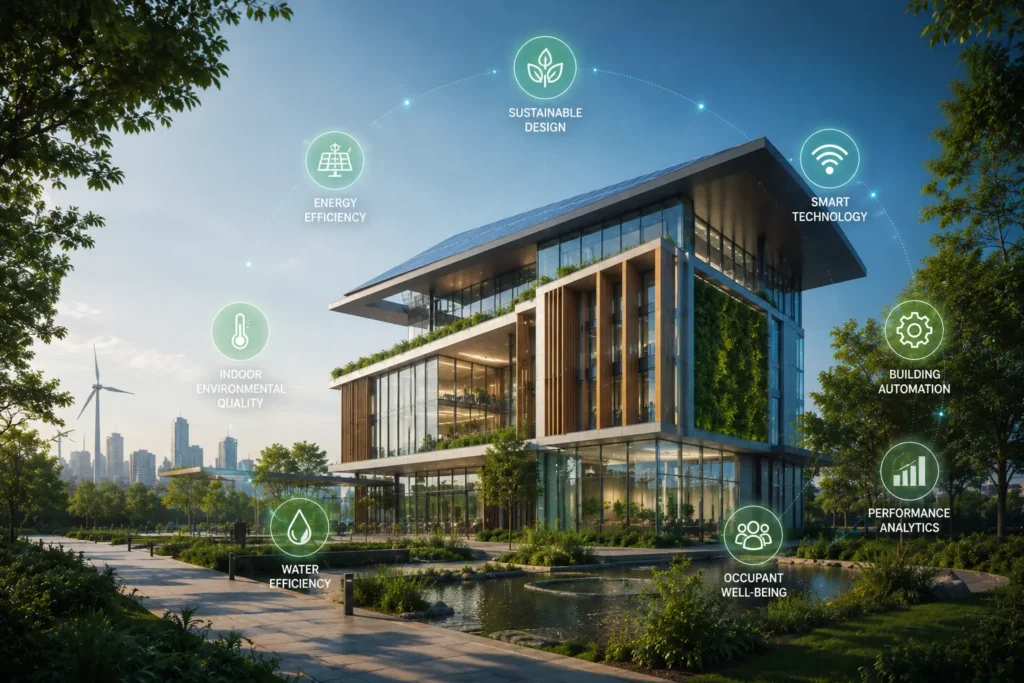
At its core, building performance measures how effectively a building fulfills its intended purpose under real operating conditions. It goes beyond architectural appearance or construction quality by evaluating how efficiently and comfortably a building functions over time.
A high-performing building is designed to achieve measurable results across several areas, including:
- Energy efficiency and reduced operational consumption.
- Occupant comfort through effective temperature control, lighting, and ventilation.
- Indoor environmental quality that supports health and wellbeing.
- Water efficiency and responsible resource management.
- Operational reliability and reduced maintenance requirements.
- Environmental responsibility through lower emissions and improved resilience.
Every element of a building contributes to performance. The orientation of the structure, the quality of the building envelope, the efficiency of mechanical systems, the selection of materials, and the integration of smart technologies all influence how the building behaves after completion.
This is why building performance should be considered from the earliest planning stages rather than treated as a final upgrade. Early decisions often have the greatest impact because they determine the fundamental relationship between the building, its users, and its environment.
Modern digital tools such as Building Information Modeling (BIM), simulation software, and monitoring platforms allow project teams to evaluate performance before construction begins. These tools help identify potential improvements, reduce inefficiencies, and create better coordination between architects, engineers, contractors, and facility managers.
For Lebanon, the Middle East, and South Africa, performance-based design provides a practical response to regional challenges. Buildings must operate effectively despite changing climates, energy pressures, resource limitations, and growing expectations for sustainability.
A building that performs well is not simply efficient when measured on paper. It is a building that continues to deliver comfort, reliability, and value throughout its operational life.
1. Building Performance Is More Than Energy Efficiency
While energy efficiency is often the first concept associated with building performance, it represents only one part of a much broader picture. A building may consume relatively little energy yet still perform poorly if occupants experience uncomfortable indoor temperatures, inadequate ventilation, poor air quality, excessive maintenance requirements, or limited flexibility for future needs.
True building performance balances multiple interconnected factors to achieve optimal long-term results.
These include:
- Energy efficiency and reduced operating costs.
- Thermal comfort throughout changing seasons.
- Healthy indoor air quality supported by effective ventilation.
- Water efficiency through responsible management and conservation.
- Structural durability that minimizes long-term maintenance.
- Occupant health, safety, wellbeing, and productivity.
- Environmental responsibility through reduced carbon emissions.
- Operational resilience and stronger long-term asset value.
The most successful projects recognize that these performance factors influence one another. For example, improving insulation not only reduces energy consumption but also enhances thermal comfort, lowers the demand on HVAC systems, extends equipment lifespan, and decreases operating expenses. Similarly, maximizing natural daylight can reduce electricity consumption while improving occupant wellbeing, workplace productivity, and overall user satisfaction.
Rather than optimizing individual systems independently, high-performing buildings are designed as integrated environments where architecture, engineering, construction, and smart technologies work together to achieve shared performance objectives.
2. Why Building Performance Matters More Than Ever
Today’s buildings operate in an environment shaped by higher operating costs, stricter sustainability expectations, advancing technologies, and changing occupant needs. As energy prices fluctuate and environmental regulations continue to evolve, developers and property owners increasingly recognize that long-term operational performance is just as important as initial construction costs.
Performance-driven design also addresses growing expectations from building occupants. People want spaces that provide comfortable temperatures, abundant natural light, healthy indoor air, good acoustics, and reliable building services. Commercial organizations seek buildings that reduce operating expenses while supporting employee wellbeing and productivity, whereas homeowners increasingly prioritize comfort, resilience, and lower utility bills.
For developers and investors, building performance directly influences financial returns. Efficient buildings typically experience lower lifecycle costs, improved operational reliability, increased property value, stronger tenant appeal, and reduced maintenance expenses. These advantages are becoming increasingly important across Lebanon, the Middle East, and South Africa, where efficient, future-ready buildings continue to gain competitive value.
Ultimately, building performance is no longer an optional design consideration. It has become a strategic investment that supports sustainability, operational excellence, occupant satisfaction, and long-term business success, helping buildings remain relevant and resilient for decades to come.
The Core Pillars of High Building Performance
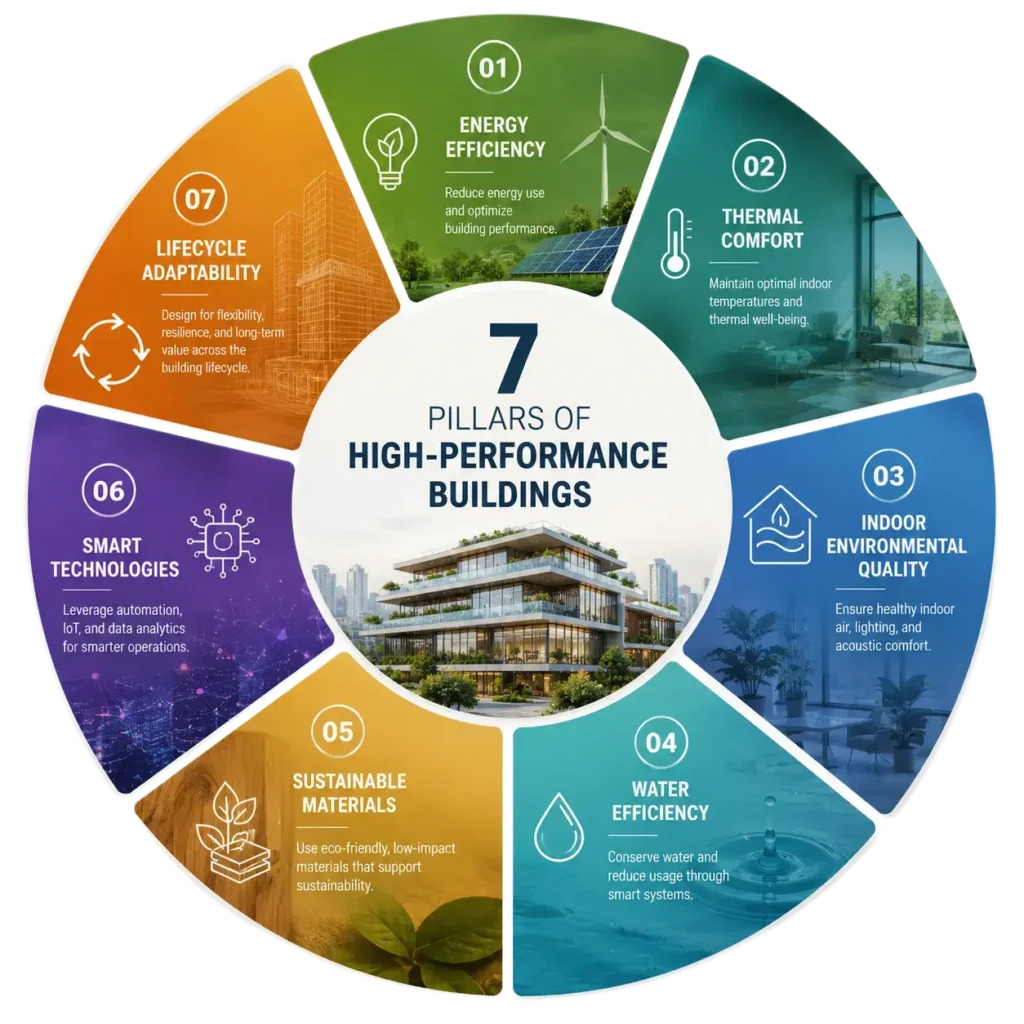
Creating a high-performing building requires a coordinated approach where every design decision contributes to efficiency, comfort, durability, and operational success. Performance is not achieved through a single technology or isolated improvement. It comes from integrating architecture, engineering systems, construction quality, and intelligent management into one complete strategy.
The following pillars form the foundation of effective building performance.
1. Energy Efficiency
Energy efficiency is one of the most visible indicators of building performance because it directly affects operating costs, environmental impact, and system reliability.
An efficient building does not simply consume less energy. It is designed to use energy intelligently while maintaining occupant comfort. This requires a combination of strategies, including:
- High-performance building envelopes that reduce unwanted heat gain and heat loss.
- Efficient HVAC systems that provide cooling and heating with lower energy demand.
- Optimized lighting solutions using efficient fixtures and daylight integration.
- Smart controls that adjust building systems based on actual needs.
- Renewable energy integration where appropriate.
For regions such as Lebanon, improving energy performance can reduce dependence on expensive energy sources and increase resilience. Across the Middle East, where cooling demand represents a major operational challenge, efficient design strategies can significantly reduce energy consumption. In South Africa, energy optimization supports operational reliability while helping buildings respond to electricity supply challenges.
The most effective approach is to reduce energy demand through intelligent design first, then integrate renewable solutions to achieve greater overall performance.
2. Thermal Comfort
A building cannot be considered successful if occupants are uncomfortable. Thermal comfort focuses on maintaining suitable indoor conditions throughout changing weather conditions while minimizing unnecessary energy use.
Achieving thermal comfort depends on the interaction between:
- Building orientation and solar exposure.
- Insulation and glazing performance.
- Natural ventilation opportunities.
- Shading strategies.
- Efficient heating, ventilation, and air conditioning systems.
Climate-responsive design is particularly important across Lebanon, the Middle East, and South Africa, where buildings must respond to different seasonal conditions.
A well-designed building works with its environment rather than constantly compensating for poor design through mechanical systems. This reduces energy consumption while creating healthier and more comfortable spaces.
3. Indoor Environmental Quality
People spend a significant portion of their lives indoors, making Indoor Environmental Quality (IEQ) a critical measure of building performance. A healthy indoor environment contributes to occupant wellbeing, productivity, and overall satisfaction.
Indoor environmental quality is influenced by several elements working together, including:
- Fresh air ventilation that maintains healthy indoor air.
- Natural daylight that reduces dependence on artificial lighting.
- Acoustic comfort that minimizes unwanted noise.
- Appropriate humidity control for healthier spaces.
- Low-emission materials that reduce indoor pollutants.
Research consistently shows that healthier indoor environments can improve concentration, reduce absenteeism, and create more enjoyable residential and commercial spaces. As organizations increasingly prioritize employee wellbeing and homeowners become more conscious of indoor health, IEQ has evolved from a desirable feature into a fundamental design objective.
4. Water Efficiency
Water efficiency has become a major consideration in regions facing increasing pressure on water resources.
A high-performing building considers water consumption from the design stage through solutions such as:
- Efficient plumbing fixtures.
- Smart irrigation systems.
- Rainwater collection where suitable.
- Greywater reuse systems.
- Leak monitoring technologies.
These strategies are particularly relevant across the Middle East, where water scarcity is a long-term challenge, as well as in parts of Lebanon and South Africa, where changing climate conditions have increased awareness of responsible water management.
Efficient water use reduces operating costs while improving the resilience of buildings and communities.
5. Durable and Sustainable Materials
Material selection has a direct impact on how a building performs over decades. While initial construction cost is often a major decision factor, the true value of a building is determined by its lifecycle performance.
Durable materials can:
- Reduce maintenance requirements.
- Improve resistance to environmental conditions.
- Extend building lifespan.
- Lower replacement costs.
- Support sustainability objectives.
Selecting materials suitable for local conditions is particularly important in regions exposed to factors such as heat, humidity, coastal environments, dust, and temperature fluctuations.
A performance-driven approach considers not only how a material looks on completion, but how it behaves years later.
Many performance-enhancing features should be considered during the budgeting stage. See our guide on the cost of building a luxury villa in Lebanon to understand how these investments affect construction budgets.
6. Smart Building Technologies
Technology has transformed the way buildings are monitored and managed. Smart building technologies allow owners and facility teams to understand how buildings actually operate rather than relying only on assumptions or periodic inspections.
Modern systems can monitor:
- Energy consumption.
- Indoor air quality.
- Temperature conditions.
- Water usage.
- Equipment performance.
- Occupancy patterns.
This information enables better decisions, from optimizing HVAC operation to identifying maintenance issues before they become costly failures.
However, technology should support building performance, not replace good design. The strongest results come when digital solutions are integrated with sound architectural and engineering principles.
7. Lifecycle Performance and Adaptability
Buildings are long-term assets that must respond to changing needs. A successful building today may need to accommodate different users, technologies, regulations, and operational requirements in the future.
Adaptable buildings are designed with flexibility in mind, allowing easier upgrades, renovations, and system improvements without major disruption.
This approach shifts the focus from short-term construction cost toward total cost of ownership, considering energy use, maintenance, operational efficiency, and future adaptability.
A building that continues to perform effectively over decades creates greater value for owners, occupants, and communities.
Bringing Every Pillar Together
The strongest buildings are not created by optimizing one system independently. They succeed because all performance factors work together.
An energy-efficient building with poor indoor air quality will not provide a truly successful user experience. A technologically advanced building with weak design fundamentals will not achieve its full potential.
The future of building performance depends on integrated thinking, where architecture, engineering, contracting, and technology work together from concept through operation.
This approach allows buildings to achieve:
- Lower operating costs.
- Improved occupant wellbeing.
- Greater resilience.
- Reduced environmental impact.
- Stronger long-term investment value.
Building Performance in Lebanon, the Middle East, and South Africa: Regional Challenges and Opportunities
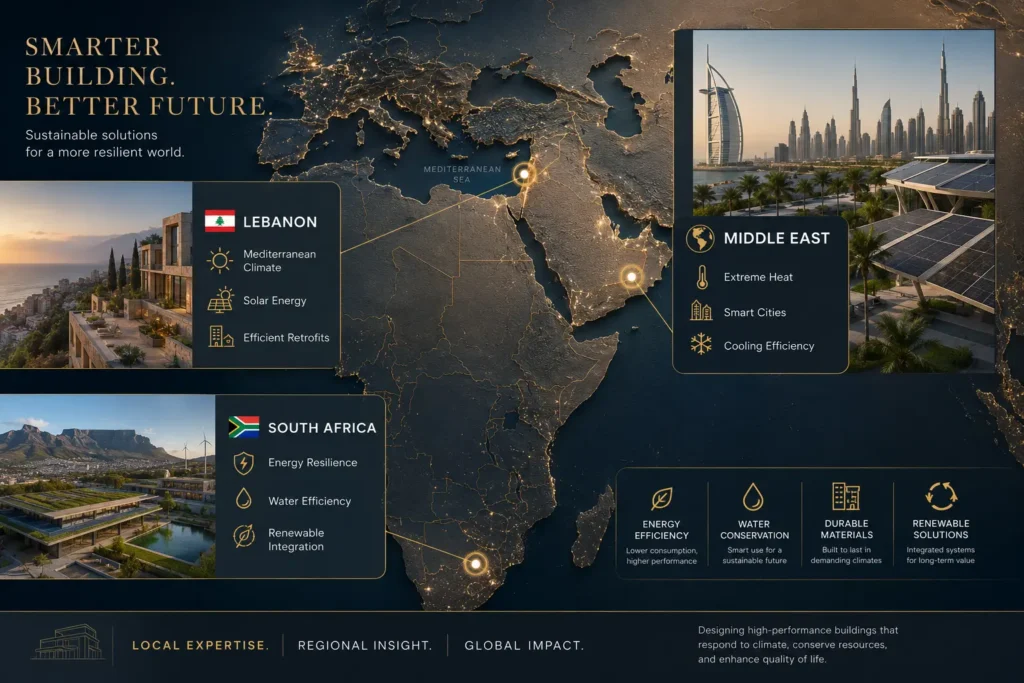
Although the principles of building performance are universal, their application must respond to local realities. Climate conditions, energy availability, water resources, construction practices, and market expectations all influence how buildings should be designed and operated.
For Lebanon, the Middle East, and South Africa, performance-driven design is becoming increasingly important as owners and developers seek buildings that provide greater efficiency, resilience, and long-term value.
1. Building Performance in Lebanon
Lebanon’s built environment presents a unique combination of opportunities and challenges. The country benefits from a diverse Mediterranean climate and strong architectural identity, but buildings also face pressures related to energy costs, infrastructure limitations, aging buildings, and changing environmental conditions.
One of the most important areas for improvement is energy performance. Many existing buildings were not originally designed to meet today’s expectations for efficiency. Improving the building envelope, upgrading insulation, optimizing HVAC systems, and integrating renewable energy solutions can significantly improve operational performance.
The growing adoption of solar energy solutions in Lebanon demonstrates the demand for greater energy independence. However, renewable energy achieves the best results when combined with efficient building design. Reducing energy demand through better architecture and engineering allows renewable systems to operate more effectively.
Climate-responsive design also plays an important role in improving performance. Effective strategies include:
- Optimizing building orientation to reduce excessive solar exposure.
- Using shading solutions to control heat gain.
- Improving natural ventilation where appropriate.
- Selecting materials suited to local climate conditions.
For residential developments, commercial buildings, and hospitality projects, improving building performance represents an opportunity to create spaces that are more comfortable, efficient, and resilient while preserving the character of Lebanese architecture.
2. Building Performance Across the Middle East
The Middle East is experiencing significant urban growth, large-scale developments, and increasing investment in smart cities and sustainable infrastructure. These changes are accelerating demand for high-performance buildings capable of operating efficiently in challenging climatic conditions.
One of the region’s most significant challenges is extreme heat. In many cities, cooling represents a substantial portion of building energy consumption. As a result, performance-driven design focuses strongly on:
- High-performance building envelopes.
- Advanced cooling strategies.
- Efficient HVAC systems.
- Smart building management systems.
- Renewable energy integration.
- Improved thermal insulation.
Water management is another critical consideration. Many Middle Eastern countries face limited freshwater availability, making water-efficient buildings an essential part of future development.
Large-scale projects across the region are also accelerating the adoption of advanced technologies. BIM, digital twins, automation systems, and artificial intelligence-based analytics are helping project teams design, monitor, and optimize buildings throughout their lifecycle.
For developers and investors, building performance is becoming a strategic advantage. Buildings that operate efficiently can achieve lower running costs, stronger sustainability credentials, improved occupant experiences, and better long-term asset value.
3. Building Performance in South Africa
South Africa faces different but equally important building performance challenges. Key priorities include energy reliability, water conservation, operational efficiency, and climate resilience.
Energy performance has become a major focus for many developments. Buildings are increasingly incorporating:
- Energy-efficient mechanical and electrical systems.
- Solar photovoltaic solutions.
- Battery storage technologies.
- Smart energy monitoring platforms.
- Improved energy management strategies.
These solutions help buildings become more resilient while reducing operational dependence on traditional energy sources.
Water efficiency is equally important. Experience with drought conditions and water shortages has increased awareness of responsible water management. High-performing buildings increasingly integrate:
- Water-efficient fixtures.
- Rainwater harvesting systems.
- Greywater reuse solutions.
- Landscape designs adapted to local conditions.
South Africa also continues to see increased interest in sustainable building standards and certifications. Developers and organizations recognize that environmentally responsible buildings can provide measurable benefits through improved efficiency, healthier spaces, and stronger market positioning.
The opportunity for South Africa lies in combining renewable energy, smart technologies, efficient resource management, and climate-responsive design to create buildings prepared for future challenges.
A Shared Regional Direction
Although Lebanon, the Middle East, and South Africa have different priorities, they share a common goal: creating buildings that deliver better performance throughout their lifecycle.
The future of construction in these regions will depend on moving beyond traditional approaches and adopting integrated strategies that consider how buildings are designed, constructed, operated, and adapted over time.
By combining local knowledge with advanced engineering practices and intelligent technologies, project teams can create buildings that respond effectively to their environments while delivering measurable benefits for owners, occupants, and communities.
Technologies Transforming Building Performance
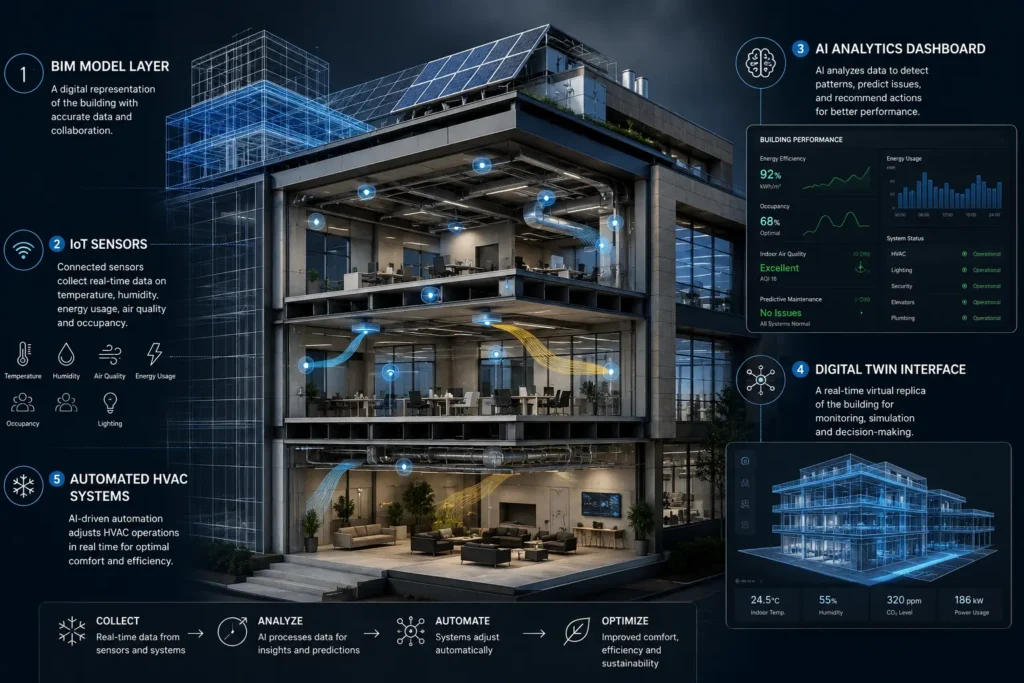
The future of building performance is increasingly connected to digital innovation. While thoughtful design and engineering principles remain essential, modern technologies now allow buildings to be measured, monitored, and continuously optimized throughout their operational life.
These solutions help project teams move from a reactive approach, where problems are addressed after they occur, toward a proactive approach focused on prediction, prevention, and continuous improvement.
1. Building Information Modeling (BIM)
Building Information Modeling (BIM) has become a powerful tool for improving building performance from the earliest project stages. Instead of relying on disconnected drawings and information, BIM creates a coordinated digital representation of a building that allows architects, engineers, contractors, and owners to collaborate more effectively.
Through BIM, teams can evaluate important performance factors before construction begins, including:
- Energy consumption scenarios.
- Building orientation and daylight performance.
- Material selection and lifecycle considerations.
- Mechanical system coordination.
- Potential design conflicts.
This early analysis helps reduce errors, improve coordination, and increase the likelihood that the completed building performs as intended.
2. Digital Twins and Real-Time Monitoring
A digital twin extends building intelligence by connecting a digital model with real operational data. Sensors and monitoring systems collect information about energy consumption, equipment performance, occupancy patterns, and indoor conditions.
This allows owners and facility managers to make decisions based on actual building behavior rather than assumptions.
Combined with artificial intelligence (AI), these systems can support:
- Predictive maintenance to identify potential equipment failures.
- Energy optimization based on real-time conditions.
- Automated system adjustments to improve efficiency.
- Performance analysis to identify improvement opportunities.
For large commercial projects, healthcare facilities, industrial developments, and smart city initiatives, these technologies provide valuable opportunities to reduce costs and improve operational reliability.
3. Artificial Intelligence and Smart Building Management
Artificial intelligence (AI) is becoming an important component of modern building optimization. AI-powered systems can analyze large volumes of operational data and identify patterns that would be difficult to detect manually.
Applications include:
- Predictive maintenance for mechanical systems.
- Automated energy optimization.
- Occupancy-based climate control.
- Fault detection and diagnostics.
- Improved facility management decisions.
Instead of operating buildings based on fixed schedules, AI allows systems to respond dynamically to actual conditions, improving both efficiency and occupant comfort.
4. Smart Sensors and Connected Systems
The growth of the Internet of Things (IoT) has introduced a new level of visibility into building operations. Connected sensors can monitor factors such as:
- Energy consumption.
- Temperature and humidity.
- Indoor air quality.
- Lighting conditions.
- Water usage.
- Equipment performance.
This data provides valuable insights that support continuous improvement and more efficient building management.
The Role of Technology in Regional Development
For Lebanon, the Middle East, and South Africa, technology offers practical solutions to many existing challenges. Whether addressing energy costs, improving resilience, reducing waste, or enhancing occupant experience, digital tools allow buildings to become more responsive and efficient.
However, technology alone does not guarantee better performance. The strongest results come when smart systems are integrated with strong architectural design, engineering expertise, quality construction, and effective facility management.
A truly intelligent building is not defined only by the technology installed inside it, but by how effectively that technology improves the way people experience and operate the space.
Even the best building designs depend on proper execution. Learn how to choose the right contractor for your construction project to ensure performance goals are achieved during construction.
Common Mistakes That Reduce Building Performance
Achieving strong building performance requires a coordinated approach from the earliest project stages. However, many buildings underperform not because of a lack of available technology or solutions, but because critical performance considerations are overlooked during planning, design, construction, or operation.
One of the most common mistakes is treating building performance as an afterthought. When efficiency, comfort, and sustainability goals are introduced late in the project, opportunities for optimization become limited and often more expensive to implement.
Another frequent challenge is focusing only on initial construction costs while ignoring long-term operational expenses. A lower upfront investment may result in higher energy consumption, increased maintenance requirements, and reduced asset value over the building’s lifecycle.
Other common issues include:
- Poor coordination between architectural and engineering disciplines, leading to inefficient systems and design conflicts.
- Insufficient climate-responsive design, where buildings fail to respond effectively to local environmental conditions.
- Selecting materials based only on cost, without considering durability and lifecycle performance.
- Installing smart technologies without a clear operational strategy, resulting in systems that are underused or poorly managed.
- Neglecting post-construction monitoring, preventing teams from identifying opportunities for continuous improvement.
A high-performing building is not created through a single decision or technology. It is the result of integrated planning, informed design choices, quality execution, and continuous management.
By avoiding these common mistakes, developers and owners across Lebanon, the Middle East, and South Africa can create buildings that deliver stronger efficiency, improved comfort, and greater long-term value.
The Future of Building Performance
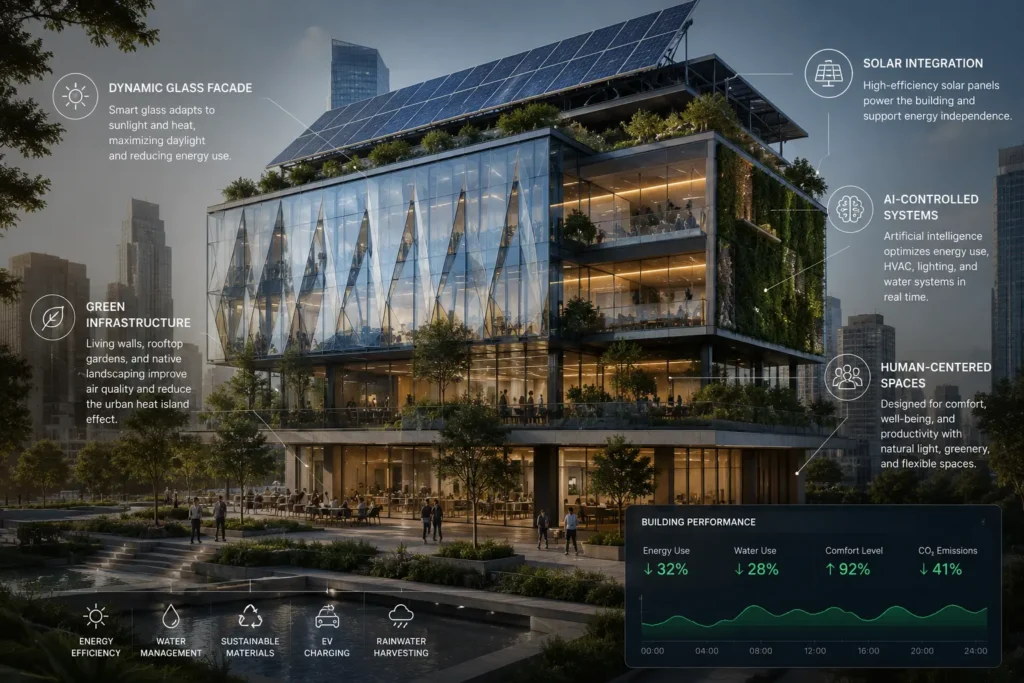
The next generation of buildings will be defined by their ability to adapt, learn, and improve over time. As climate challenges, technology, and user expectations continue to evolve, buildings will become increasingly intelligent and responsive.
One major direction is the development of net zero and low-carbon buildings, where designers consider not only operational energy use but also material impacts, embodied carbon, and lifecycle emissions.
Another important trend is the expansion of AI-driven building optimization. Future buildings will increasingly use real-time data to adjust systems, improve efficiency, and anticipate maintenance requirements.
Adaptability will also become essential. Buildings designed with flexibility can respond to changing occupancy patterns, new technologies, and future requirements without major disruption.
Across Lebanon, the Middle East, and South Africa, these trends represent an opportunity to create buildings that are more resilient, efficient, and prepared for future challenges.
The goal is no longer simply to construct buildings. The goal is to create buildings that continue to perform better throughout their entire lifecycle.
Frequently Asked Questions
What is building performance?
Building performance measures how effectively a building operates throughout its lifecycle, including energy efficiency, occupant comfort, indoor quality, resource management, and operational costs.
Why is building performance important?
Building performance helps reduce operating costs, improve occupant wellbeing, increase building resilience, and enhance long-term asset value.
What makes a building a high-performance building?
A high-performance building combines efficient design, advanced engineering systems, quality construction, smart technologies, and effective operation.
How does building performance improve energy efficiency?
Building performance improves energy efficiency through better building design, efficient HVAC systems, smart controls, optimized lighting, and renewable energy integration.
What is the difference between sustainable design and building performance?
Sustainable design focuses on reducing environmental impact, while building performance measures how effectively a building operates in real-world conditions.
How does BIM improve building performance?
BIM improves building performance by helping teams analyze, coordinate, and optimize building design before construction begins, reducing errors and improving efficiency.
How do smart buildings improve performance?
Smart buildings use sensors, automation, and data analytics to monitor and optimize energy use, comfort, maintenance, and overall building operations.
What is a digital twin in building performance?
A digital twin is a real-time digital model of a building that uses operational data to monitor performance, predict issues, and improve efficiency.
Why is building performance important in Lebanon, the Middle East, and South Africa?
Building performance helps address regional challenges such as energy costs, extreme climates, water efficiency, and the need for more resilient buildings.
Can existing buildings improve their performance?
Yes. Existing buildings can improve performance through retrofits such as insulation upgrades, efficient systems, smart monitoring, and renewable energy solutions.
Sources & Methodology
This article was developed using international building performance standards, industry research, and regional construction insights to explore how smarter buildings can improve efficiency, comfort, resilience, and long-term value across Lebanon, the Middle East, and South Africa.
The content draws on guidance and research from:
- International Energy Agency (IEA) – Building energy efficiency and decarbonization research
https://www.iea.org/topics/buildings - World Green Building Council (WorldGBC) – Sustainable and high-performance building frameworks
https://worldgbc.org - ASHRAE – Building systems, HVAC performance, and indoor environmental quality standards
https://www.ashrae.org - BuildingSMART International – BIM and digital construction standards
https://www.buildingsmart.org - Green Building Council South Africa (GBCSA) – Regional sustainable building practices
https://gbcsa.org.za
The article combines global best practices with regional considerations, including climate response, energy efficiency, smart technologies, and lifecycle building performance.
Designing Buildings That Perform for the Future
Across Lebanon, the Middle East, and South Africa, the need for smarter buildings continues to grow as owners and developers face changing climate conditions, rising operational costs, resource challenges, and increasing sustainability expectations. Addressing these challenges requires a collaborative approach where architecture, engineering, contracting, and technology work together from the earliest stages of a project.
By prioritizing energy efficiency, occupant wellbeing, resource management, and long-term adaptability, projects can deliver greater value for owners while creating healthier and more sustainable environments for communities.